Metrics: Revenue
Disclaimer: I am not a Certified Public Accountant (CPA), and this article is not intended as financial or tax advice. The information provided here is for educational and informational purposes only. Please consult with a qualified accounting professional or CPA for advice specific to your agency's financial situation.
Revenue is the money an agency brings in from its activities. For most, this will be the services it sells, but it could also include product sales if your agency produces a product.
Revenue, in concept, is straightforward. But there are a couple of things to keep in mind with revenue when setting KPI targets and goals.
Accrual vs. Cash
Whenever you’re introducing KPIs that incorporate revenue or expenses, you should clarify whether the data uses accrual accounting or cash accounting.
Accrual
Accrual records the revenue when the work occurs.
Use accrual-based numbers when calculating project profitability and unit economics (i.e., Revenue-per-Hour, COS-per-Hour).
Aside: Some accounting software treats accrual as when the invoice was generated – not when the hours were worked. This isn’t very helpful, so just know that when you generate a report in QuickBooks with “accrual” based numbers, the numbers don’t actually correspond to when the work was performed.
Cash
Cash records the revenue when payment is received.
Use cash-based numbers in matters related to cash flow (i.e., bonuses, commissions, invoice aging).
Pass-through expenses
On a lot of client projects, the agency needs to make a purchase on behalf of the client. For example, let’s say a client is going to pay $1,000 for a license, but the agency is making the purchase. The $1,000 that the client pays the agency should not be counted as revenue; and the $1,000 the agency spends to purchase the license should not be counted as an expense (the cash flow should appear on the balance sheet as a temporary asset/liability). Consult with your accountant to see if this is consistent with your bookkeeping, but generally speaking, I feel it’s best to keep these pass-through purchases off your profit and loss statement.
Here’s what happens if you don’t:
Let’s say you’re billing $150 per hour for your services; an 8-hour business day generates $1,200. Your Cost of Services per hour is $80, or $640 for the day. So your services are generating $560 in gross profit (46.7% gross margin).
Now let’s say your agency purchases a $1,000 license on this day. If that $1,000 was not treated as a pass-through, but instead appeared as a cost, it would look like your COS for the day was $1,640. So your services would be generating a $440 loss (-36.7% gross margin). That’s misrepresenting how profitable your service work was that day, in my opinion.
Revenue Lookup Table
So how much revenue should your billable team members be generating each year? You can use the table below to see, based on a person’s salary and your gross margin target:
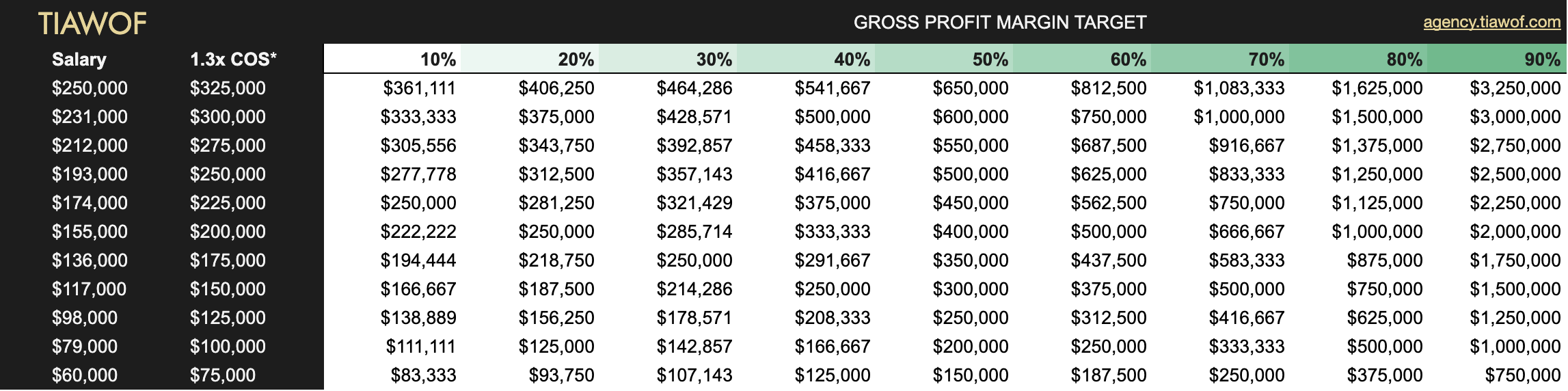
Note: The U.S. Small Business Administration estimates that the all-in cost of an employee is 1.25x to 1.4x their salary (https://www.sba.gov/blog/how-much-does-employee-cost-you); I’m using 1.3x in the table above.
As the lookup table shows, an employee making $117,000 per year needs to generate $300,000 in revenue for a 50% gross profit margin. If they bring in $250,000, they’ll have generated a 40% gross profit margin.
Additional help
If you’d like support setting revenue targets or accurately tracking revenue on an accrued basis, I provide consulting and fractional leadership that can help you get started. I’m also happy to refer you to partners I’ve worked with on the accounting and bookkeeping front.
Just get in touch. ❦
