The First Business Developer
For most small agencies with fewer than ten or so people, the founder is the linchpin of business development. This is due to external and internal pressures. Externally, in the new business phase, clients want to work directly with the people who own the business; they want to know that their money is being spent on work that the owner will directly vouch for. Internally, the agency rarely has another team member with the skills needed to charm clients, instill confidence in them, and scope the work to their budget. So the founder is, essentially, the Director of Business Development.
At agencies of this size, the founder is also the de facto head of: Client Services, Finance, HR, IT, Marketing, Operations, and Strategy. They lead everything, and they finish each 60-hour workweek with more work than they started with. Their calendar looks like a Paul Klee painting:

Paul Klee, May Picture
In any given week the founder is:
Responding to inbound leads (Business Development)
Taking calls with prospective clients (Business Development)
Preparing and presenting proposals for new business (Business Development)
Negotiating with legal on MSA and SOW terms (Business Development)
Attending networking events if the business pipeline is lean (Business Development)
Shamefully (and futilely) cold emailing if the pipeline is dead (Business Development)
Posting on social (Marketing)
Speaking at events (Marketing)
Writing case studies and marketing materials (Marketing)
Updating the company website (Marketing)
Reviewing client work before it goes out (Client Services)
Calming down anxious clients (Client Services)
Doing the actual client work Sunday at 9 pm (Client Services)
Forecasting finances (Finance)
Managing cash flow (Finance)
Processing payroll (Finance)
Approving expenses and reimbursements (Finance)
Sending invoices (Finance)
Chasing down overdue invoices (Finance)
Securing a line of credit (Finance)
Hiring (HR & People)
Onboarding new team members (HR & People)
Answering questions about benefits (looking up the answer) (HR & People)
Mediating interpersonal disputes (HR & People)
Updating the employee handbook (HR & People)
Retaining the strongest performers (who could get paid more somewhere else) (HR & People)
Negotiating salaries (HR & People)
Conducting performance reviews (HR & People)
Managing under-performing team members (HR & People)
Firing people when necessary (HR & People)
Responding to Glassdoor reviews (HR & People)
Supporting a team member dealing with an issue outside of work (HR & People)
Planning company events (HR & People)
Dealing with software subscriptions (IT)
Troubleshooting IT issues (IT)
Re-organizing the company Google Drive (IT)
Negotiating the office space lease (Operations)
Managing the business insurance (Operations)
Trying not to get sued (Operations)
Being sued (Operations)
Working with legal so we don't lose everything (Operations)
Strategy: Developing the business strategy
Handling anything that needs to be "escalated."
Not taking a vacation so we don't lose everything
Ironically, the work the founder is uniquely suited for – leading the business strategy (i.e., why the agency should exist) – they don’t have time for. It’s one of those tasks that is so ambiguous, existential, and lacking in urgency that it is continuously deprioritized.
Fast-forward a few years. If the agency survives without a coherent strategy, it will do so having amassed a portfolio of disparate past projects. It will “do everything well,” which doesn’t resonate with a customer who needs one thing done in particular. And it will likely have a team of wonderful people with redundant skills at overlapping seniority levels who don’t have a domain of problems they’re uniquely well-suited to solve. Because without a business strategy, the agency has worked on whatever random projects it could win to keep the lights on, and it hired based on the availability of team members to take on each random project.
The founder wants to avoid this. They want to be intentional about the work the agency is known for and the team they’ve built around them. So they resolve to find time for business strategy.
The problem of developing business
Business Development is the lifeblood of the agency. The founder knows this, and that’s why they’ve historically prioritized it: taking all of the calls with prospective clients on inbound leads, estimating and scoping the work, creating and sending the proposals, and of course, pitching the work. Parts of this they actually enjoy – like getting into the details of the project requirements (they’re a creative after all) – but do you know what they loathe in business development? Outbound. Prospecting. Sending cold emails. It’s drudgery, but it’s work they need to do when the business pipeline is lean.
But the pipeline isn’t lean. And when the agency is wrapping up a particularly good stretch of months with high utilization and healthy profits, the founder’s mind wanders to hiring their first business developer. It’s difficult not to envisage them with a halo radiating overhead, this person who will spare them from business development and allow them to start working on the agency.
But the founder isn’t naive, they know it will be difficult.
First, they’ve never hired for business development. They can hire for design, or engineering, or even project management on intuition alone, but business development is an entirely different beast. They themself learned business development on the job, and they don’t know what they don’t know, so interviewing candidates who likely know more than they do feels daunting. Plus, aren’t business developers going to be inherently good at talk and selling (themselves, in this case)?
Second, the founder has reservations about someone else being the face of the agency. This business developer will be the first person prospective clients interact with. From the first follow up email on an inbound inquiry to the intro call with the client, the business developer needs to represent the agency flawlessly. If they don’t follow up with clients promptly or impress with their communications, the agency could lose leads that it can’t afford to lose. Even more important to the founder, the reputation of the agency could take a hit, which could really set the business back, not to mention their own reputation.
The final hurdle in bringing on a business developer is compensation. Someone who is going to secure projects that grow top line revenue 20% - 30% year-over-year will command top dollar. Their baseline salary will be right up there with the highest paid team member and that’s before commissions or performance bonuses. And it could be 3, 6, or 9 months before the agency sees the impact of even an exceptional BD person. The founder isn’t sure they can afford to float a business developer for that long, and they certainly can’t afford to hire one that flops.
Reframing the problem
There’s another way the founder can think about the problem.
First, they need to acknowledge how their personal preferences may be clouding what’s best for the business. They need to set aside what they would like to be focusing on and accept what they need to be focusing on – the work that only they can do given the current team: strategy and business development.
They don’t enjoy business development work, but if they want to build a sustainable agency for tomorrow, they need to continue with the difficult work today. This means continuing the grind of business development until the agency has grown to the point where it has the cash reserves needed to safely hire for the role and not be ruined by a bad hire.
Let’s revisit what’s on the founders plate. If the founder picks up strategy and business development, let’s take a look at how their workweek starts to look:
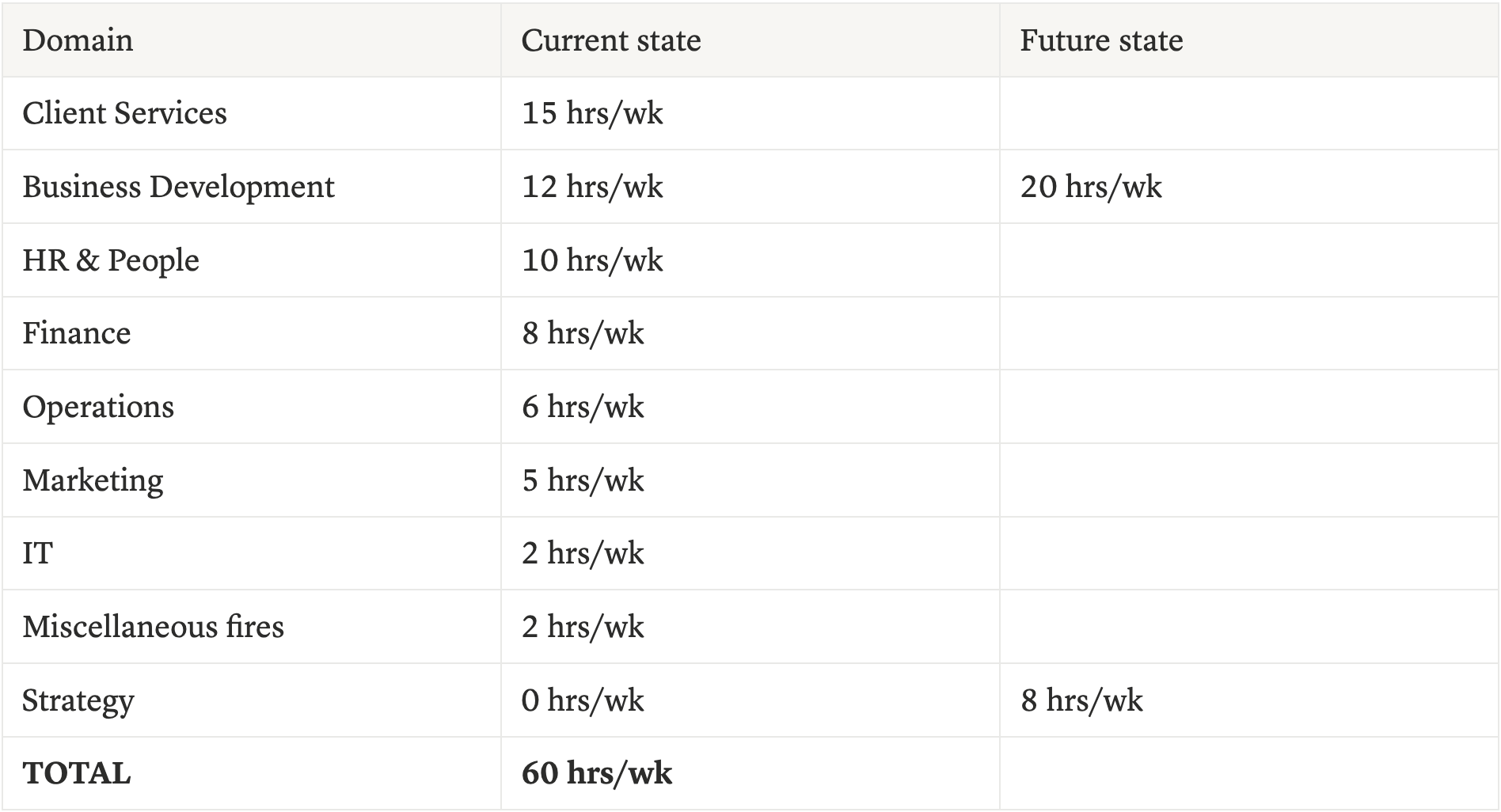
We’re going to increase the amount of time the founder spends in Business Development each week to 20 hours/week, because this is what’s going to enable the agency to grow faster to hire a business developer.
The founder has been burning the candle at both ends for a while now, so let’s target 50 total working hours per week, instead of 60. With Business Development and Strategy estimated to 28 hours/week, we have 22 more hours to assign. Here’s how we’ll do it:
Miscellaneous fires – known unknowns – are going to come up, so let’s assume that’s constant at 2 hours/week spent there. (30 hrs total)
Ensuring high quality work for existing clients is critical, so let’s keep those 15 hours on their plate. (45 hrs total)
Next, we need to anticipate the founder’s additional hours in Business Development yielding more projects. More projects means we need more people, so we should budget time for the founder to be involved in hiring. With writing job descriptions, reviewing applicants, and interviewing, let’s estimate an average of 6 hours/week. (51 hours total)
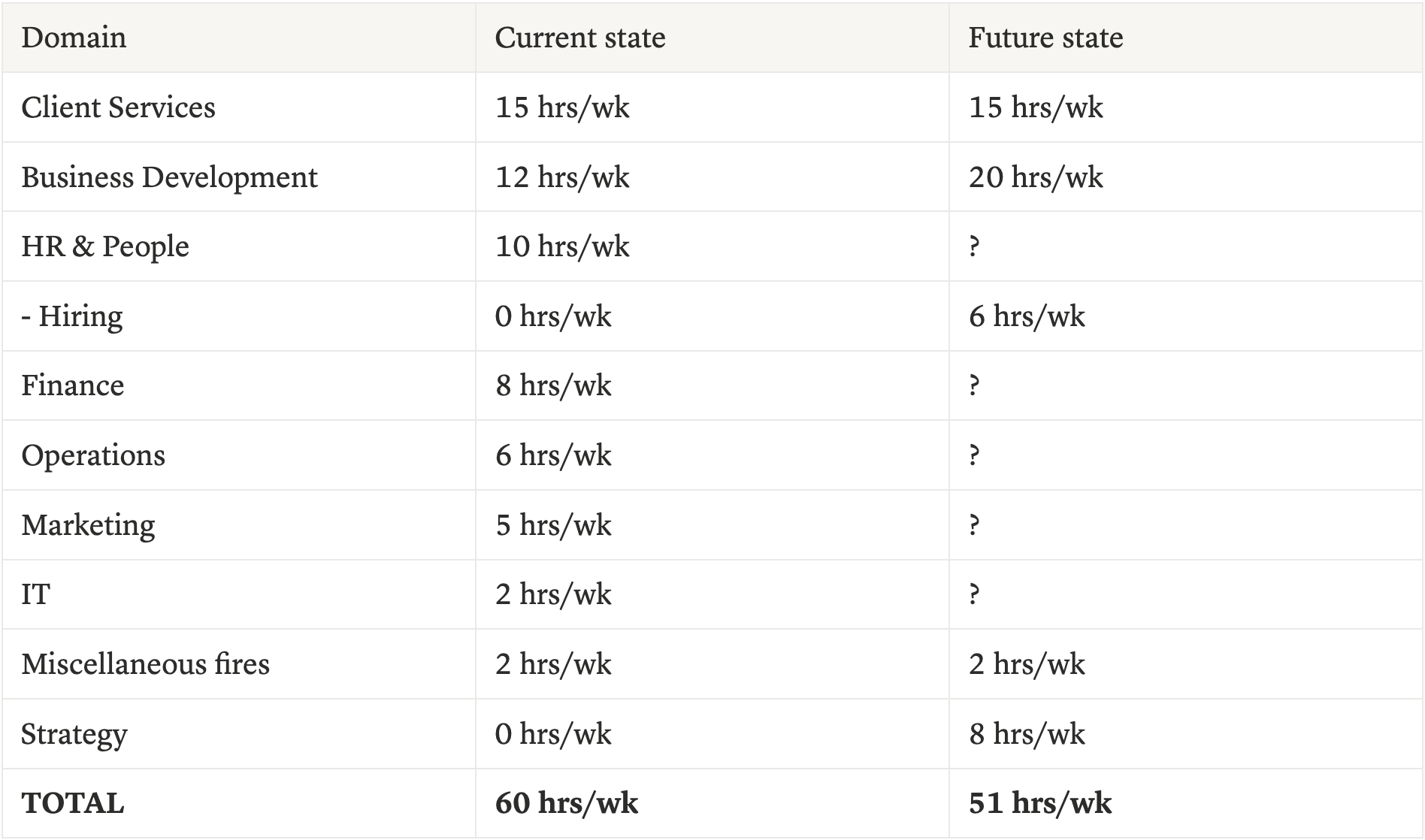
We’re a little over 50 hours/week, but at this point, we’ve honed in on work for the founder that:
Is high leverage for growing the agency
Their role is uniquely well-suited for
Aligns with their skills
Next, we need to take care of work in the other domains: finance, HR, IT, marketing, and operations. This is work that’s going to increase as the agency grows and doesn’t align well with the founder’s skills or interests anyway.
Solving the problem
What the founder needs to do next is find partners who can take on the remaining work.
The money that they previously would have used to roll the dice on an under-compensated business developer can be allocated to bringing on part-time contractors and service providers at a competitive rate.
Eventually, as the agency grows, it can replace those external partners with full-time hires once the workload and finances make sense to bring the work in-house.
This is a work of friction
What we’ve done here is remove the points of friction in the agency’s operating system.
So long as the founder is over-allocated, performing necessary work that is not high impact, and neglecting impactful strategy work that doesn’t feel urgent, the agency will have plateaued. Instead, we solve for challenges in business development not by pushing harder on the point of friction (i.e., hiring a business developer to bring in more business), but by removing the points of friction that are limiting the founder from doing business development.
⁂
One of the reasons I started this practice is to help small agency owners navigate these inflection points. Do you know where friction is holding back your business pipeline, potential projects, creative teams and managers, and ultimately, yourself? Where does your agency need traction in order to deliver better work or to get to the next level? ❦
Need help bridging the gap in business development before hiring you first director?
