Hiring Full-Time Employees vs. Contractors
This article mostly focuses on the financials of hiring full-time employees (FTE) vs. contractors. There’s plenty to be written about the cultural, legal, and operational side, as well; I hope to cover that in a future article.
⁂
Historically, digital agencies have relied on contractors and freelancers to provide services they don't offer in-house. This subcontracting allows agencies to present a more comprehensive offering to potential clients and put forth a more competitive project proposal. It also reduces risk and overhead for the client team, who might otherwise need to engage multiple agencies or contractors to complete a project. The subcontracting should also result in better work, as the agency is bringing in a specialist in the work area.
But something's shifted. Anecdotally, it feels like agencies are increasingly relying on contractors for more than just augmenting their primary services: contractors are increasingly being brought on to deliver the agency's core services, right alongside full-time team members.
For evidence, just look at the number of job postings on agency career pages denoted as "contract-only" or "part-time." Or have you noticed how many agency career pages note that they're not hiring right now, but freelancers are encouraged to submit their information to join the agency's pool of talent?
Tapping into contractors for primary services allows agencies to scale up and scale down with demand. But this approach presents some real risks that are worth examining.
Relying on contractors for core services
Timing is a huge factor. If a great contractor that you've worked with before is not available (or has taken a full-time role elsewhere), you may need to work with a contractor you're not familiar with.
Working with a contractor you're not familiar with is risky, no matter how strong their references are. This is because the contractor is working with a new team for the first time, and a reference can’t predict how smoothly the new team will transition from forming to performing (per Tuckman’s stages of group development). The work will probably go well if the contractor is experienced at joining new teams and your team is adept at integrating external partners. But for most agencies, there just aren't enough client projects where you can roll the dice on vetting new contractors without risking the agency’s reputation.
As more agencies trim their full-time teams and rely more on contractors, this will increasingly become a problem. Don't take for granted the access and availability you have to a great, full-time team that has trusted creatives and collective chemistry.
Good contractors are expensive. Depending upon how commodified their expertise is, the hourly cost of the contractor could be $50 to $100 more per hour than that of a full-time employee.
That being said, the economics on hiring a contractor often work because you're not paying that contractor between projects. That's when the costs of full-time employees catch up with the hourly rate of a contractor on a project: agencies need to factor in non-billable or "bench time" for their full-time employees. From a financial perspective, this is the key consideration in deciding whether to hire contract work at a higher hourly rate or hire full-time employees to do the work at a lower rate.
The financial breakdown
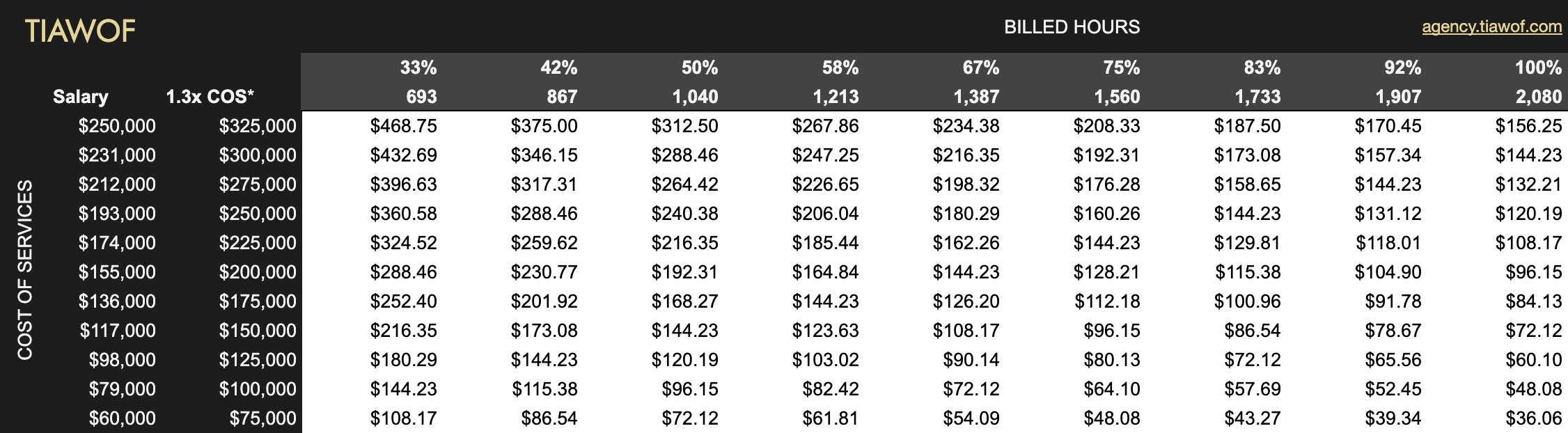
The table above shows the cost of a full-time employee per billed hour (based on their Cost of Services). You can see that the more hours we can sell for the person, the lower the cost per hour is. (I’m using 2,080 hours (52 weeks at 40 hrs/week) as 100% utilized in the table above, but 92% utilization is probably closer “full utilization” with PTO taken into account).
For example, let’s say an agency is debating between hiring a new full-time employee or contracting. A team member being paid $117k in salary ($150k all-in Cost of Services) costs $144.23 per hour if they’re 50% utilized (1,040 sold hours per 12 months):
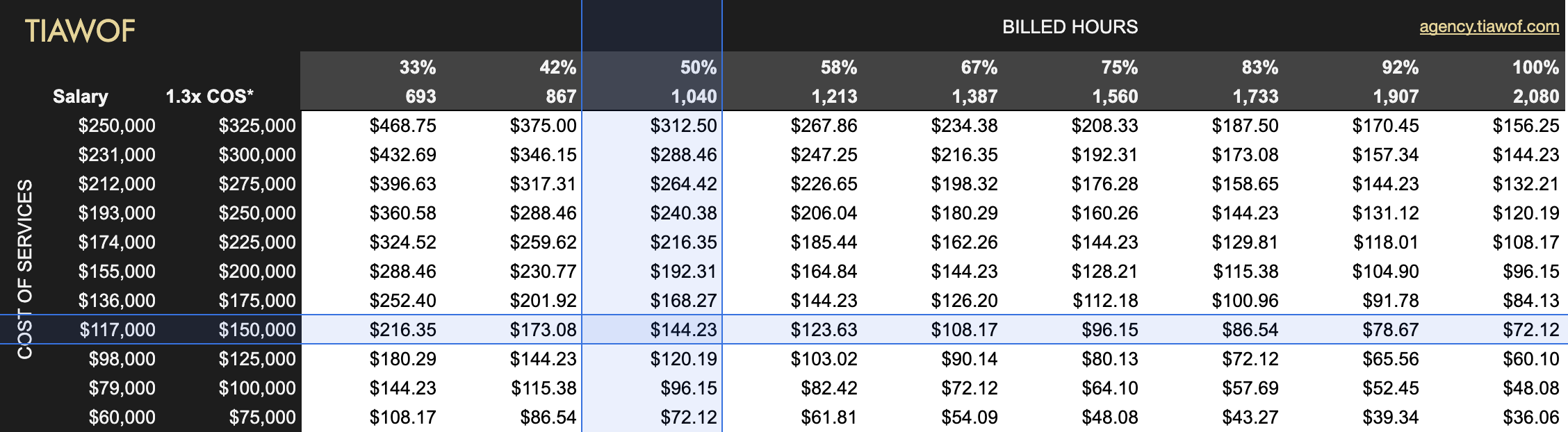
If the agency can’t improve utilization for this person, it would be more cost effective for them to hire a contractor at a rate of $144.23 or less (assuming the bill rate to the client is the same). This assumes the agency will be able to align contractor availability perfectly with the start and end of projects to realize all of the 1,040 billed hours, which may not be realistic.
But let’s look at what happens if the agency can improve a FTE’s utilization from 50% to 75% by selling an additional 520 hours (i.e., 13 weeks):
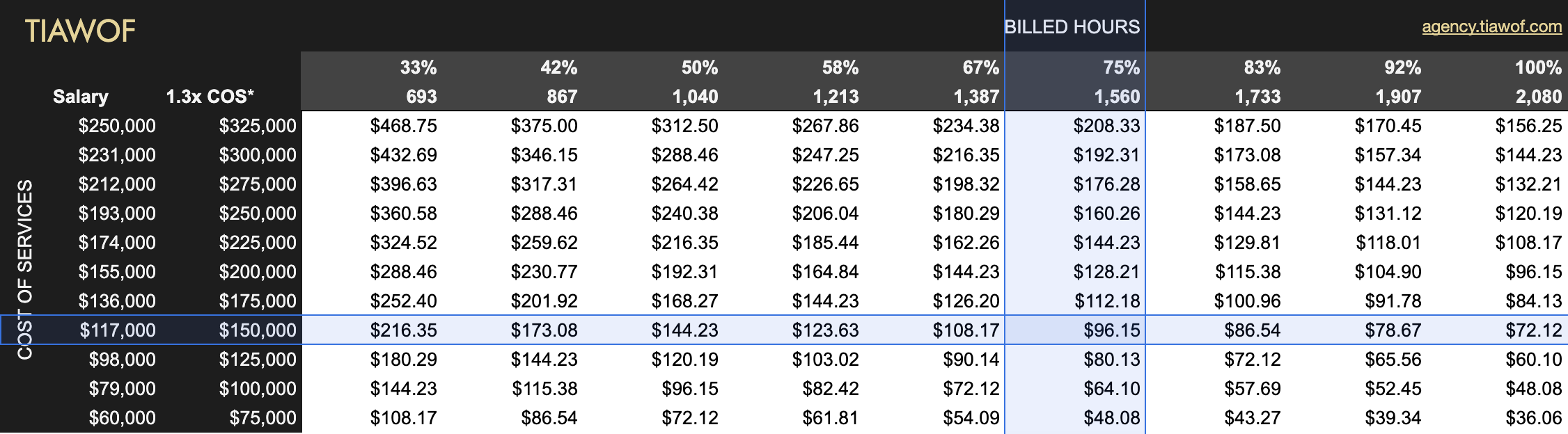
The full-time employee’s cost per hour drops from $143.23 to $96.15.
Let’s look at two scenarios to factor in the cost of a contractor. In both scenarios, the agency realizes $175/hr in revenue.
Scenario A: over a 12-month period, there are 1,050 hours that the agency manages to sell of a full-time team member; this means they would be 50% utilized:

In this example, the FTE generates $29,900 in profit. If the agency had instead contracted out those 1,040 hours to a contractor charging the agency $125/hr, it would have generated $52,000. Financially, the agency is better off contracting in this scenario.
Scenario B: if the agency can improve utilization to keep a FTE billable for 1,560 hours (75% utilized), the full-time team member is more profitable than the contractor:

Above, you can see that the full-time team member generates $120,900 in gross profit – $42,900 more profit than the contractor would have, even being on the bench for 25% of the time.
Note that in both scenarios, the contractor is generating a consistent Gross Profit Margin of 28.6%. That’s because the contractor is only paid for hours billed to the client – there’s no bench time to cause the gross profit to fluctuate. The problem is, the contractor’s hourly rate is more expensive and the agency can rarely mark up their rate enough to sustain a healthy margin on their hours (e.g., 50% - 60%). So by hiring a contractor, the agency is protecting the downside risk of being under-utilized in Scenario A; but it’s also limiting the upside profit it could realize it it needs to utilize contractors more than expected over 12 months (Scenario B).
Making the decision
The key in deciding between full-time hires and contractors is for the agency to anticipate what future project work is going to look like. I can see you, loyal reader, rolling your eyes. But isn’t this exactly what the business does every day when it continues to exist? It sets its feet out of bed and says, the market needs me today.
The key here is that agencies need to move beyond looking at the projects that are active in their pipeline today; they need to build their team for all of the projects that will be in the pipeline in the future. To do this, the agency needs to anticipate future projects based on it’s business development activities today. This means agencies need to have good data around the outcomes of their efforts. They should have a sense of the ROI from business development activities, be it publishing case studies, in-person networking, or outbound. If a partner spends 8 hrs/week on business development efforts, how many leads does that yield? Ideally, the agency is breaking their lead volume, win rates, and revenue down by services (and the skills needed to deliver those services) to inform hiring.
Agencies can also look at the historical hours they've allocated to contractors. If they expect future demand for those services to be similar in the future, they can hire a full-time person and should have an understanding of how much additional business they need to win to keep that FTE utilized with better profit margins than a contractor would have had.
This system isn't perfect, and hiring is risky, but the alternative is even less appealing: if you need to contract to the point that you don't have strong margins for your core services, you’re guaranteeing mediocre business performance. If everything goes right, the agency still misses it’s profit targets.
Closing thoughts
Outsourcing for core services over the long-term feels like an anti-pattern. If this is happening, the agency should consider the breadth of their service offering: it could be too broad. Consider scoping down the service offering and focusing on lead generation for the services that you can most distinguish the agency on and develop a full-time team around.
The more an agency is able to outsource it’s primary services, the less likely it is to have actual differentiation in the problems it solves for clients. Well, we have a process, it might say. But can a creative services firm’s "secret sauce" be so reliant on it’s process that team members can be swapped in and out and the output retains they agency’s identity? Maybe the creative or technical direction on each project is enough to keep its work different and yet still distinguishable, regardless of the individual contributors, but I’m skeptical.
If you’re struggling to find the right full-time-to-contractor balance…
